You can have a visually perfect design and a technically flawless solution, but if the user on the page doesn't know what to do, your product has failed. In the world of web design too often we focus on colours, element layouts and smooth animations, while the most important thing - the words - are dealt with at the very end. UX writing and microcopy are disciplines that turn dysfunctional and confusing websites into intuitive tools that generate revenue.
These texts do not form long paragraphs. They are often just two or three words, but they carry a huge responsibility: they must safely guide the user through the entire process from the first click to a successful conversion.
What is UX writing and what is its role
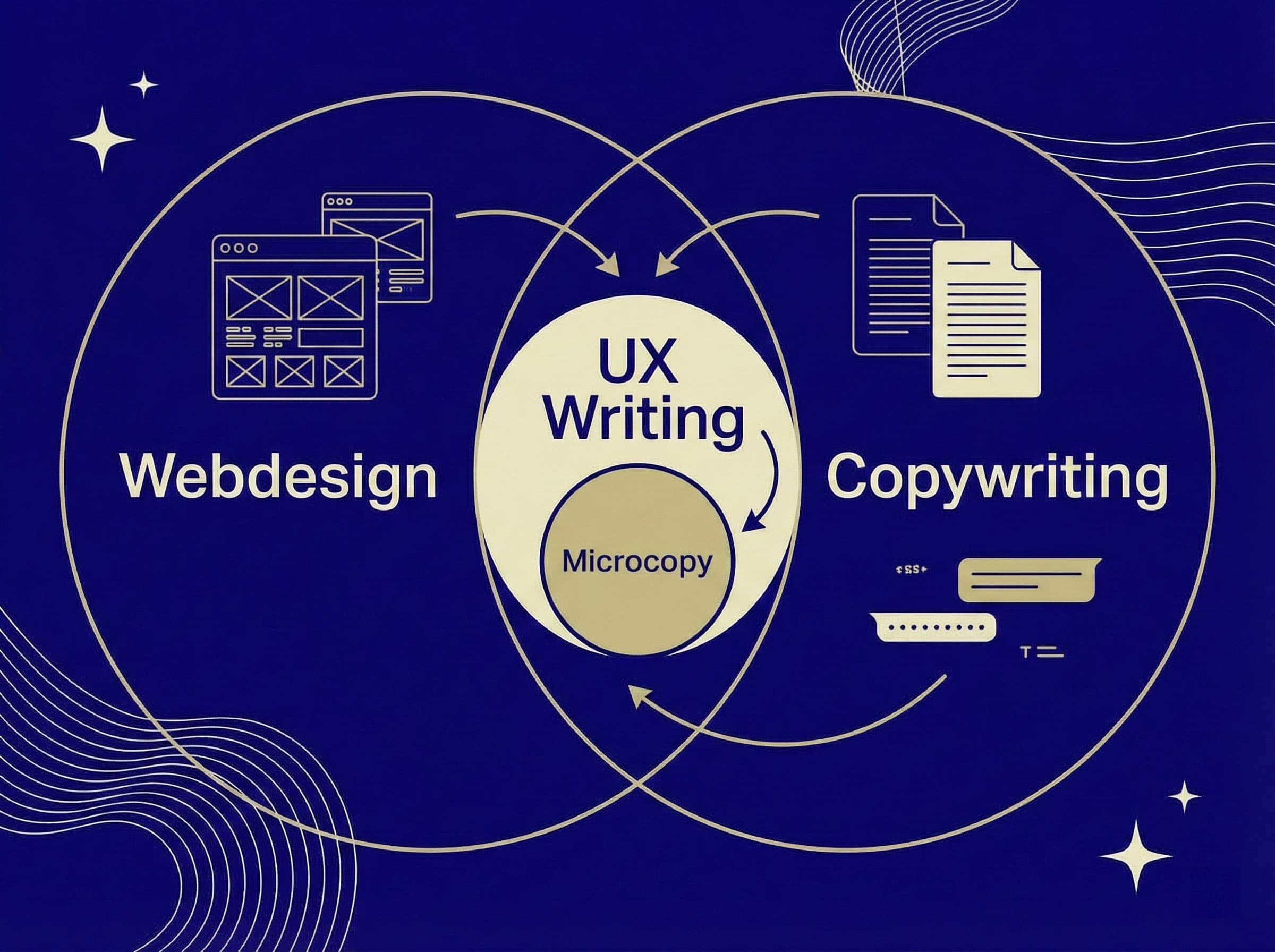
UX writing is the design of the conversation between a digital product and a human. Includes the overall strategy of the texts in user interface (UI). Its goal is not to dazzle the user with creativity, but to remove friction, minimize cognitive load and avoid frustration.
A good UX writer focuses on ensuring that the entire website or application communicates consistently and clearly. They address the overall information architecture, naming of the main menu categories, tone of voice & tone, and onboarding processes. Real interest and strategy is the key - texts must not be created as a design filler, but must be based on a deep understanding of the problem the user is coming to the website with and the emotional state they are in.
What is microcopy and what is its power
While UX writing represents the overall strategy, microcopies are specific, small texts scattered all over the interface. It is the little words that have the biggest impact on decision-making at critical moments.
This typically includes:
- Texts on the buttons (Call to Action).
- Help in forms (placeholders and labels).
- Error messages and warnings.
- Confirmation messages (e.g. successful sending of payment).
- Texts for empty states (e.g. when the shopping cart is empty).
If the microcopy is debugged, the user usually doesn't even notice it because it naturally slips through the process. But if it's spelled wrong, it causes confusion. A typical example is a button that says „Next Step“. The user doesn't know what they are committing to. Change to „Proceed to transport selection“ immediately reduces uncertainty and increases cart throughput.
Fundamental difference: ux writing vs. copywriting
These two disciplines are often confused, but in practice they stand on opposite sides of the spectrum. They have completely different goals, metrics of success and ways of creating.
| Parameter | UX writing a Microcopy | Marketing Copywriting |
| Primary objective | Perform, help, facilitate a task, speed up orientation | Captivate, persuade, create desire, sell |
| Stages of the customer journey | Action (user already wants to do something) | Getting attention (user just considering) |
| Style and tone | Clear, concise, functional, empathetic | Creative, emotional, salesy, punchy |
| Typical location | Buttons, forms, error messages, navigation | Landing pages, PPC ads, emails, blogs |
| Key Metrics | Reduced error rate, process completion (Task success rate) | Click-through rate (CTR), time spent on the page |
Both disciplines must complement each other on a quality website. Copywriting brings the user to the website and gets them excited about the service, while UX writing then „sweeps them along“ to the point of sending an enquiry. However, an experienced „copywriter“ can handle both in practice and also have a slight overlap and say in web design.
4 places where bad text most often kills conversions
When reviewing a site for usability, most errors occur in these critical areas:
- General and unclear buttons: The „Send“ or „Confirm“ buttons make people fear the unknown. The user doesn't know whether they are sending a non-binding request or whether they are ordering a paid service. The button should always accurately describe the action that follows the click.
- Threatening error messages: There is nothing worse than the red text „User error: invalid format“.
Good microcopy never puts the blame on the visitor. Instead, it offers a solution: „Somehow this phone number doesn't fit. Please check if it has 9 digits.“ - Dead Ends (Page 404): A common 404 error page will drive the user straight off the site.
The UX approach will use this page as a safety net. It will explain what happened and offer links to the most popular products, a search box or direct contact to support. - Intimidating forms: If you require sensitive data (for example, a phone number), you must immediately explain to the user why you need it and what you will do with it. A short note „We only need the number for the courier, we won't call you with offers“ can radically reduce the rate of form abandonment.
Professional integration into web development
For microcopy and UX writing to work, you can't stick them into the design until just before launch. An expert team is always involved in delivering a superior output, where the UX designer, developer and copywriter work together from the first rough sketches (wireframes). Texts must influence design and design must give space to texts.
From the perspective of modern web management, it is also crucial that the system provides flexibility and freedom. If the analytics data shows that users do not understand the wording of a particular step in the order, the site owner must be able to immediately modify the wording in the administration, deploy an A/B test and measure the result without having to wait for the programmer to modify the code.
At the same time, the optimization of these elements is a continuous process. In modern DFY (Done For You) In Apadore, we take full responsibility not only for the initial texting, but also for the long-term data evaluation (heatmaps, screen recordings) and continuous polishing of the user journey so that the website delivers maximum performance. Contact us, we will be happy to help you with the creation or redesign of the site.
Frequently asked questions (FAQ) about UX writing
Who should write UX texts for the web?
The ideal solution is a dedicated UX writer involved directly in the interface design. If you don't have such a specialist, the text should be written by the person who best understands user research and customer behaviour (often a UX designer), not a purely technical developer or creative copywriter focused only on sales.
How do I know if my microcopy is bad?
The best indicator is user analytics and feedback. If you're getting the same questions to customer support, if users are abandoning the shopping cart in bulk at a particular step, or if tools are recording „rage clicks“ (frustrated clicks on inactive elements), the interface communication is most likely failing.
Does UX writing affect SEO?
Quality UX writing definitely has a positive effect on SEO. Although UX texts are not primarily used to insert keywords, they directly influence the User Experience. If a website is easy to understand and people can easily find what they are looking for, they will spend more time on it and not immediately return to the search results. Search engines carefully evaluate these behavioural signals and reward sites with good UX with better positions.