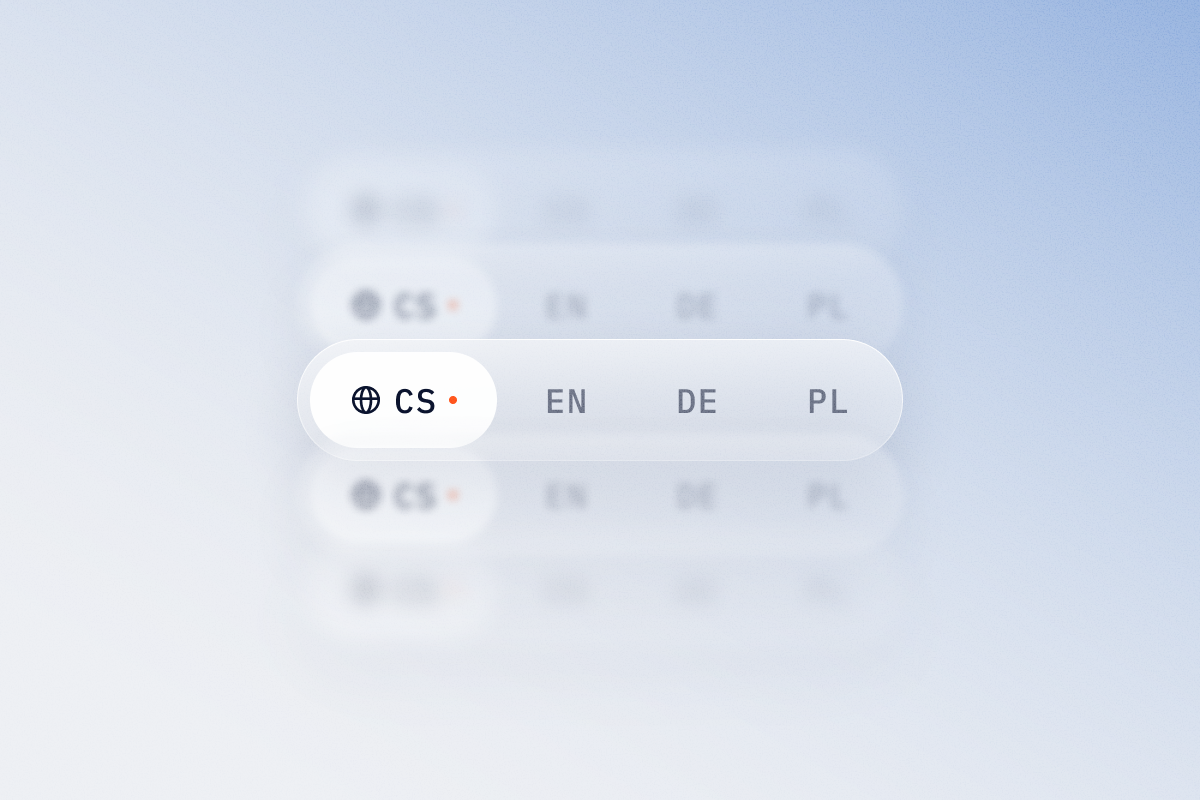
Why have a website only in Czech when you can simply translate it into other languages? After all, all you have to do is get it translated, and that’s it, right? That’s exactly where you’re wrong. Multilingual websites come with several problems that aren’t immediately obvious. What are they?
A multilingual website sounds like a piece of cake. That is, until you realize just how much work it actually takes. In one of our projects, RoboTwin, we really had to dig deep because of that. The process actually required far more steps than it initially seemed.
A clickable button isn't enough
You want to expand and decide to launch a multilingual website. That makes sense. And it’s a great step toward further growth. But there’s a catch. Most companies take a simple approach to this: We have a website, so we'll just translate it a Add a clickable button.
In practice, however, as always, it's a little more complicated than just feeding the content into a translator.
Where might you run into a problem?
5 Pitfalls of Multilingual Websites
It's not just about linguistic correctness. The foreign context and the structure of the language play a role, as do technical settings and administration. Here is 5 traps, which you may encounter when creating a multilingual website.
1. This website only makes sense in the Czech Republic
Not everything that makes sense in the Czech Republic makes sense elsewhere.
Some websites for foreign markets You just don't need it. Before you start translating, go through the content and decide what should truly adds value for a specific market.
For example, a German customer might be much less interested in Czech case studies than in a case study relevant to his own context. Therefore, you don't need to copy the entire Czech website word for word. Just the relevant information is enough.
2. The layout gets messed up with the translation
German or English text It can be significantly longer than the Czech version. And if the design doesn't account for that, headings will start to wrap, buttons will overflow, or entire sections will be scattered.
That's why it's a good idea to take the length of the text into account as early as the design phase. If you decide to expand later, you may need to adjust the layout.
3. There's no one to manage the website
You can find a translator for a one-time job. But who will handle the translations a year from now? You’ll add the new product to the Czech version, but who will add it to the German and English versions? If you don’t have a clear process in place, The language versions will begin to diverge.
So think it through right from the start, Who manages the translations, and how are changes reflected in the other languages?.
4. SEO for Each Language Separately
SEO for each market separately. Literally translated keywords aren't what people in that country are actually searching for. Every market has slightly different phrases, customs, and ways in which people search for services or products.
For example, the Czech keyword „Web Development“ It may not have the greatest potential in Germany as a literal translation. Keywords must therefore be analyzed separately for each language and each market. As a result, you SEO will cost you Even double or triple that.
5. You make one change three times
Any changes you need to make to the website, is multiplied. Are you adding a new product or article? It's not enough to create it just once.
If you have three language versions, You'll have to do the same work three times – from translation to proofreading to publication itself. This will cost you more time and money.
Where should you start when creating a foreign-language website?
We don't want to scare you. Multilingual websites are, of course, a great tool for expansion. But you can't start with a translation—you have to start with a question:
Do we really need that many languages, or just the ones where we actually sell our products?
Before you dive into translating the entire website, try focusing on, what makes the most business sense. It's not necessary to have everything in ten languages right away. It's better to prepare two perfectly polished language versions than five that aren't worth anything.
Are you expanding your website to other languages?
We'll design and build a multilingual website that search engines and AI agents in every country can find.
Expansion? Yes, but with caution
A multilingual website is a great tool for expansion—if you approach it the right way. At Apador, we’ll help you design both the structure and the technical solution so that your website delivers results and doesn’t become a nightmare to manage.
Would you like some advice on which languages are right for you? Sign up for a free consultation and let's find the best solution.