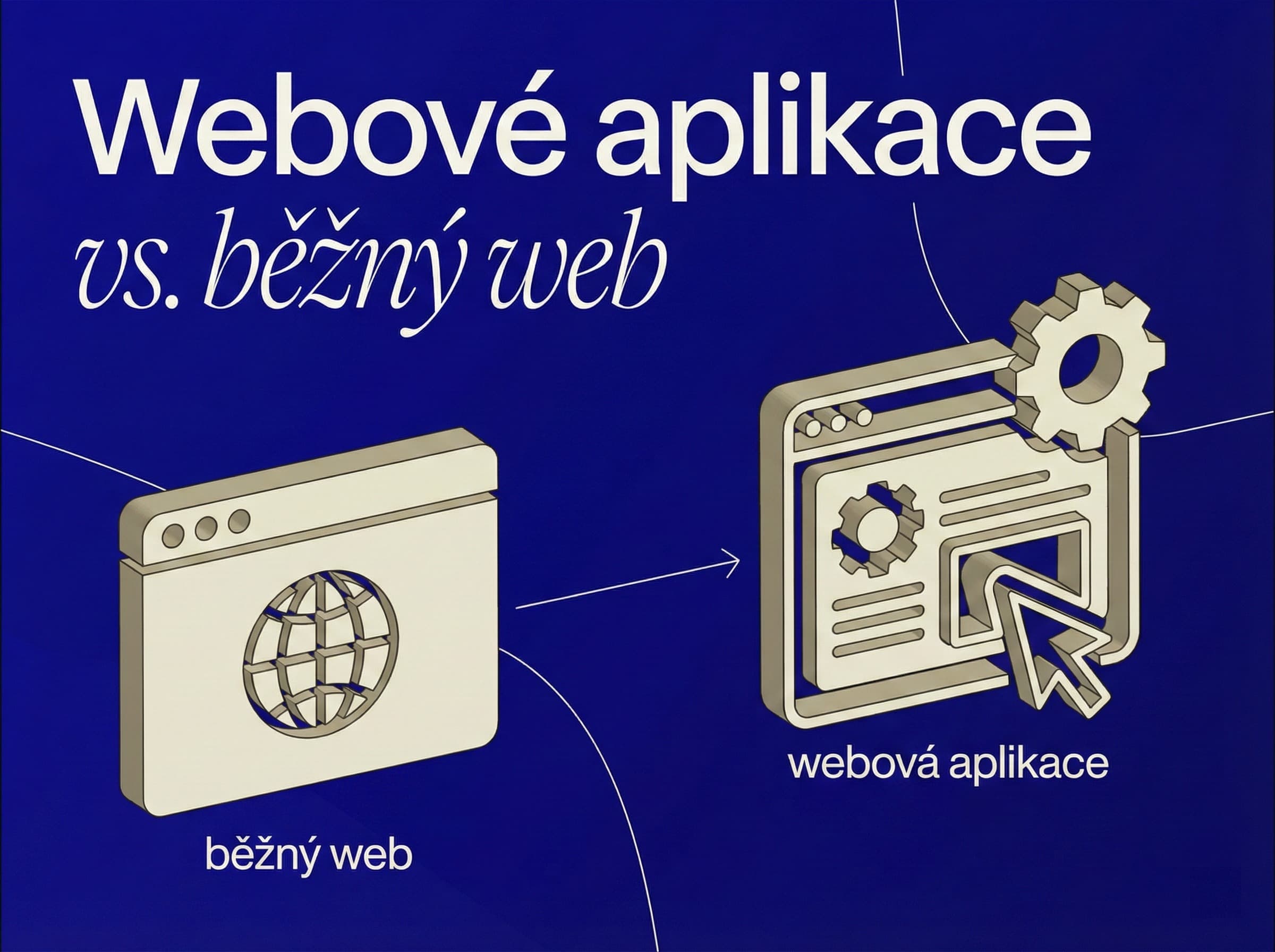
In the digital space, the terms „website“ and „web application“ are often loosely confused. From the perspective of the average user, the line can be blurred - both run in a web browser and have their own URL. However, in terms of development, purpose and business strategy, the two diametrically opposed Instruments.
A web application is a software solution accessible through a web browser that allows the user to perform specific tasks, manipulate data and interact with the system in real time. Unlike a static website, which only presents information, the application actively interacts with the user.
Basic principle of operation
The web application works on a client-server model.
- Client (Frontend): What the user sees in the browser. It provides display and interaction.
- Server (Backend): „The “brain" of the application running on the remote computer. It processes requests, performs calculations and communicates with the database.
When a user performs an action in the application (for example, submits a form or filters products), the request is sent to the server, which processes it and sends back the result without necessarily reloading the entire page. This provides a smoothness and speed that is close to the desktop experience.
Website vs. Web App: what are the differences?
Understanding this difference is key to correctly specifying a development request. While a presentation website aims to inform, a web application aims to solve a problem or automate a process.
| Parameter | Website (Web) | Web application (Web App) |
| Main purpose | Information, presentation (reading content) | Functional, interactive (performing tasks) |
| Interaction | Passive (clicking on links, reading) | Active (data entry, calculations, account management) |
| Authentication | Usually not necessary | Often requires user login |
| Example | Business card, blog, news portal | Gmail, Trello, Internet banking, CRM |
| The complexity of development | Lower (emphasis on design and content) | High (emphasis on logic, security and data) |
In practice, these worlds often intersect. For example, an e-shop is a catalogue (web) from the visitor's point of view, but the process of shopping cart, ordering and client zone is already a pure web application.
Key benefits of web applications for business
The shift from desktop programs (which must be installed) to web-based applications is one of the main trends in the digitalisation of companies. The reasons are pragmatic.
1. Platform and device independence
The web application does not need to be installed. It works on Windows, macOS, Linux, but also on mobile phones and tablets. All you need is a web browser. This brings a huge flexibility and freedom for users and employees who can work from anywhere.
2. Centralised administration and updating
For traditional software, each user must update their device. For the web application, the update takes place on the server. All users have immediate access to the latest version, security patches and new features. This saves IT administration costs.
3. Scalability
A well-designed web application can grow with the company. Whether it's used by ten people or ten thousand, the architecture (with the right cloud solution) allows you to scale up performance as needed without having to rewrite all the code.
Types of web applications in practice
Web applications cover a wide range of tools. The most common types that can be encountered when digitizing processes include:
- E-commerce platforms: Complex systems for online sales (B2C and B2B portals).
- Portals and client zones: Secure sections of websites where clients can see their invoices, order status or communication history.
- Internal company systems (ERP/CRM): Internal applications for customer relationship management, warehouse management or project management tailored to specific company processes.
- SaaS (Software as a Service): Products that a company offers as a service to others (e.g. billing tools, reservation systems).
Progressive Web Apps (PWA) are a recent trend
A specific category that has dominated development in recent years is the so-called Progressive Web Applications (PWAs). These are web apps that behave like native mobile apps.
The user can „install“ the PWA on their phone's desktop directly from the browser (without having to go to the App Store or Google Play). Such an app can:
- Work offline (or on a bad connection).
- Send push notifications.
- Use hardware functions (camera, GPS).
For many companies, PWA is a more efficient option than developing an expensive native app because one code can serve both desktop and mobile.
The development process: from strategy to code
Web application development is a more demanding discipline than creating a presentation website. It requires the involvement of expert team, which includes not only programmers, but also UX/UI designers, analysts and testers. The process typically involves:
- Analysis and strategy: Before writing the first line of code, it is necessary to understand the business problem. Real interest and strategy are crucial at this stage - the goal is not to create an application, but to solve a specific need (e.g. to speed up order clearance).
- Prototyping (UX/UI): Creation of wireframes and graphic design. User-friendliness is tuned here.
- Development: Programming of the frontend and backend parts. Emphasis is placed on data security and speed of response.
- Testing: Verify functionality across devices and browsers.
- Deployment and maintenance: The application is a living organism that requires monitoring and further development.
At our place in Apadore we work within the model DFY (Done For You). As suppliers, we take responsibility for the entire process creation web applications. You define the goals, we handle the technical details of implementation, technology selection, developer management, etc..
When should I decide to develop my own web application?
Investing in customized development makes sense when box solutions are no longer sufficient or are hindering the growth of the company:
- If you need to digitize unique corporate know-how.
- If you want to offer your customers a superior service through the client portal.
- If you are linking data from several different systems into one clear dashboard.
A custom web application becomes a digital asset of a company that increases its value and efficiency.
Are you considering developing a web application or client zone?
We will be happy to discuss your project with you, assess the technical requirements and we will propose a solution, that will make economic and user sense.