The way users and systems navigate the Internet is undergoing the biggest change in a decade. Traditional traffic from traditional search engines is beginning to complement, and in some segments replace, traffic from AI agents and language models (LLMs). The problem is that the current web was built for humans, not artificial intelligence.
While humans easily ignore visual noise on a page (menus, footer, banner ads), HTML code is a huge burden for an AI robot. Cloudflare therefore introduced a new feature in February 2026 Markdown for Agents, which addresses this problem directly at the network infrastructure level and shows the future direction of technical SEO.
How automatic conversion to Markdown works
Markdown is a simple markup language that has become the unofficial standard for AI communication. It preserves the logical structure of text (headings, lists, tables) but completely removes complex HTML code, CSS classes and scripts.
The Cloudflare function works on the principle of the so-called. content negotiation.
- When a regular user comes to the web via a browser, the server delivers a classic HTML page by default.
- However, if an AI agent (such as Claude Code or the OpenAI search engine) enters the site and specifies in its request via the HTTP header that it prefers the format
Accept: text/markdown, ...Cloudflare will intervene. - The Cloudflare network (CDN) downloads the original HTML from your server, converts it to pure Markdown in real time in the background and sends the robot this lightweight version.
Here's a diagram of exactly how the Markdown feature for AI agents works:
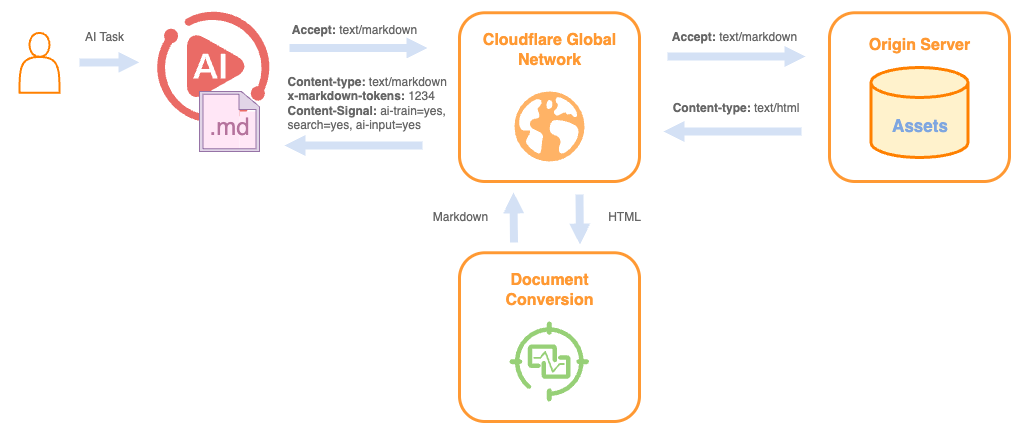
The original server (your web host) still works as before and you don't have to program any complex parallel versions of the site.
How to enable Markdown for AI agents
To turn on Markdown for Agents in the dashboard, do the following:
- Log in to Cloudflare dashboard ↗ and select your account (you need a tariff to activate For or Business).
- Select the zone you want to configure.
- Go to section AI Crawl Control ↗.
- Turn on (Enable) the function Markdown for Agents.
Why Markdown is key for AI
This technical change has three major implications for how effectively AI can process your website content.
1. Massive token savings (up to 80 %)
Artificial intelligence does not read text word by word, but by tokens. Processing each token costs computing power and money. Cloudflare reports that the average HTML article consumes over 16,000 tokens due to invisible code (<div>, <script>, ). The same article converted to Markdown only consumes around 3,000 tokens.
To get a better idea, take a look at the comparison of how the same content for a simple heading and a single paragraph looks in both formats:
Classic HTML code (full of structural noise):
HTML
    O us


        We are an expert team focused on <a href="/web-at-peace" class="link-primary">website development and SEO.
Pure Markdown (semantics and content only):
Markdown
## About us
We are an expert team focused on [web development](/web-at-peace) and SEO.
While the HTML version contains dozens of formatting tags (classes for colors, spaces and wrapping containers) that have absolutely no meaning for understanding the text, Markdown passes only pure information and logical structure to the AI model. For language models (LLMs), it's like the difference between having to read all the barcodes, recycling marks and technical instructions for the bearer on the envelope, versus just reading the actual contents of the letter inside.
2. Preliminary size calculation
Cloudflare adds a useful header to the response x-markdown-tokens. It tells the robot in advance how long the document is. The agent can then decide immediately whether the text fits in the „context window“ without having to download and parse the whole thing.
3. Higher accuracy of AI responses
The less code and visual ballast the AI model has to filter, the less chance there is of so-called hallucination. Clean structured text leads to much more accurate and relevant citations of your content in the final answers.
| Parameter | Classic HTML | Pure Markdown |
| Designed primarily for | Human readers (rendered in browser) | Machine processing (AI agents, LLM) |
| Information noise | Extremely high (scripts, styles, layout) | Minimal (pure content structure only) |
| Token consumption | Very high | Low (reduction of up to 80 %) |
A new level of control: Content-Signal Headers
With the advent of AI, website owners are rightly concerned about their data. Who is downloading content and what is it being used for? Traditional file robots.txt serves only to prohibit entry but cannot specify the purpose.
Part of the Markdown for Agents solution is therefore the deployment of the so-called. Content-Signal headers. These act as machine-readable conditions of use. The site owner can specify in detail whether the downloaded content may be used for:
ai-train(training new AI models),search(display in search results),ai-input(direct replies to users in chat).
This is a huge shift in copyright protection and control over one's digital assets.
Is it safe from the point of view of Google and cloaking?
When this news was announced, the SEO community debated whether Google would start penalizing websites for so-called. cloaking (a deceptive technique whereby different content is shown to the search engine than to the real user). Google representative John Mueller has previously commented that creating parallel sites just for bots is a „stupid idea“.
However, Cloudflare does not use risky robot detection (User-Agent sniffing), but standard HTTP negotiation. The content is identical in terms of information, only the formatting is changed on the basis of an explicit request from the client. While there is a theoretical risk here (e.g. a conversion error that would hide important text), from a technical perspective this is a legitimate traffic optimization that can fundamentally improve the readability of your site for AI models. And like Google, for language models, making your site readable also increases the likelihood of its visibility.
How to prepare a website for AI agents (even without Cloudflare)
Even if your site does not use Cloudflare infrastructure (or a premium plan where the feature is available), Generative search engine optimization (GEO) is becoming a necessity. You can apply the basic principles immediately:
- Implement advanced structured data (JSON-LD): Tag articles, FAQ sections and products so that machines understand the context.
- Deploy standard /llms.txt: It is an emerging convention that works similarly to robots.txt, but specifically for language models. This file, located in the root directory, provides AI agents with a simplified map of the content and context of the site in pure text form, making it much easier for them to navigate and extract key information.
- Rethink the content structure: Use a clear hierarchy of headings and place a short, punchy answer at the top of each important section (the Answer-First approach) that AI can easily pick up.
- Allow AI robots access: Check if your file
robots.txtdoes not unnecessarily block modern search bots like OAI-SearchBot, who create the index for ChatGPT.
Markdown for Agents is just one piece of the puzzle; the other is whether you allow AI bots to access your website at all. Starting September 15, 2026, Cloudflare will block AI training bots by default for both new and free websites, and this change can inadvertently affect traditional search bots as well. We discuss when to keep the setting as is and when to adjust it in our article on AI Robots on the Web.