The question of how to get on the first page of Google as quickly as possible or List, falls at the beginning of almost every digital project. From a business perspective, it's a perfectly logical requirement - visibility brings traffic and traffic generates conversions. However, it is essential to separate marketing myths from technical and strategic realities of search engines.
This article explains how search engines work, why there is no magic button for instant success, and what specific steps lead to the fastest possible growth in organic traffic.
Why there is no instant SEO
The basic principle of search engine optimization (SEO) is building trust. Search engine algorithms need time to index a site, understand its content and evaluate the domain authority. The new website finds itself in a sandbox, where Google tests it before giving it top positions for important keywords.
If an agency or consultant promises a „first position within a week“, they are most likely using prohibited (black-hat) SEO techniques. These manipulative methods may bring a short-term spike in traffic, but inevitably lead to fast and permanent penalization of the entire site, from which it is extremely time-consuming and costly to return.
Quick results vs. long-term stability (PPC vs. SEO)
If a business requires traffic immediately (for example, to run a time-limited campaign), organic search is not the right tool.
- PPC advertising (Pay-Per-Click): It's the only way to instant visibility. By paying the credit, the site will immediately appear in sponsored positions above the natural results. But once the budget runs out, visibility immediately drops to zero.
- SEO (Organic Search): It builds a long-term digital asset. While with PPC you pay per click, organic traffic brings users steadily and the return on investment (ROI) is disproportionately higher in the long run.
Three pillars: How to maximize growth rate
Although the process cannot be skipped, with the right strategy and technical design it can be significantly streamline and speed up. Success rests on three fundamental pillars that must work together.
1. Flawless technical basis
Search engines prefer sites that are fast, secure and easy to navigate. Here it turns out that quality SEO cannot be separated from professional Web design.
- Loading speed: If a page takes longer than 3 seconds to load, most users leave. Search engines automatically move slow sites to lower positions.
- Mobile responsiveness: Most searches today are done on mobile devices (mobile-first indexing).
- Clean architecture: A logical URL structure and proper internal linking helps robots find and index new content faster.
2. Focus on „Long-tail“ keywords
The biggest mistake that hinders the growth of websites is trying to target highly competitive one-word terms (e.g. „furniture“). The fastest way to the first page is to use long-tail phrases. These are more specific, multi-word queries (e.g., „customized solid oak dining room table“). While these queries have a lower overall search rate, they are characterised by minimal competition and huge conversion potential, because the user knows exactly what he wants to buy.
3. Content that solves a real problem
Texts on the web must not be written for search bots, but for humans. The key is real interest and deep understanding of the problem, with which the user comes to the website. If the visitor finds a meaningful solution, they spend time on the site and take an action (e.g. fill in a form). The search engine evaluates this behaviour as an excellent user experience (UX) and the site moves up in the results.
General principles: how to prepare a website for flash indexing
Before you can actively submit your website to search engines, it must be technically sound. Even the fastest request will fail if the robot hits obstacles. Here are the basic steps that must always be addressed, regardless of the specific search engine:
- XML sitemap generation: Sitemaps work like digital map of your website, which clearly shows robots all existing and important subpages. Our websites provide flexibility and freedom by generating the sitemap automatically in the background whenever new content is added.
- Smart internal linking: Isolated pages without links are very slow to index. The best strategy is link to new content from an existing, strong site (for example, linking to a new article from a highly trafficked homepage or from a major category service such as SEO or Webdesign). The robot follows the link and discovers the news immediately.
- Removal of technical blockages (noindex): During development, the site is often hidden from the public using the noindex tag. An extremely common error after launch is that this marker remains in the code. Always check the settings, otherwise search engines will ignore the page completely.
- A regular publication with added value: Robots are more likely to return to websites that are regularly revived with new content. But the goal is not to create empty text for algorithms. The key is real interest and strategy - only publish content that actually addresses your questions and problems target groups.
How to get your website into specific search engines
Each search engine has its own specifics and tools. Setting up these platforms is a standard part of our approach when our expert team delivers the website to the client already fully connected to the necessary analytics, so that he does not have to delay technical operations. But let's still go through the steps that will help make your website more visible.
1. Google and Google Search Console (GSC)
Google is the global leader in search, and you can't manage your website without the free Search Console. It serves as the main communication channel between you and the search engine.
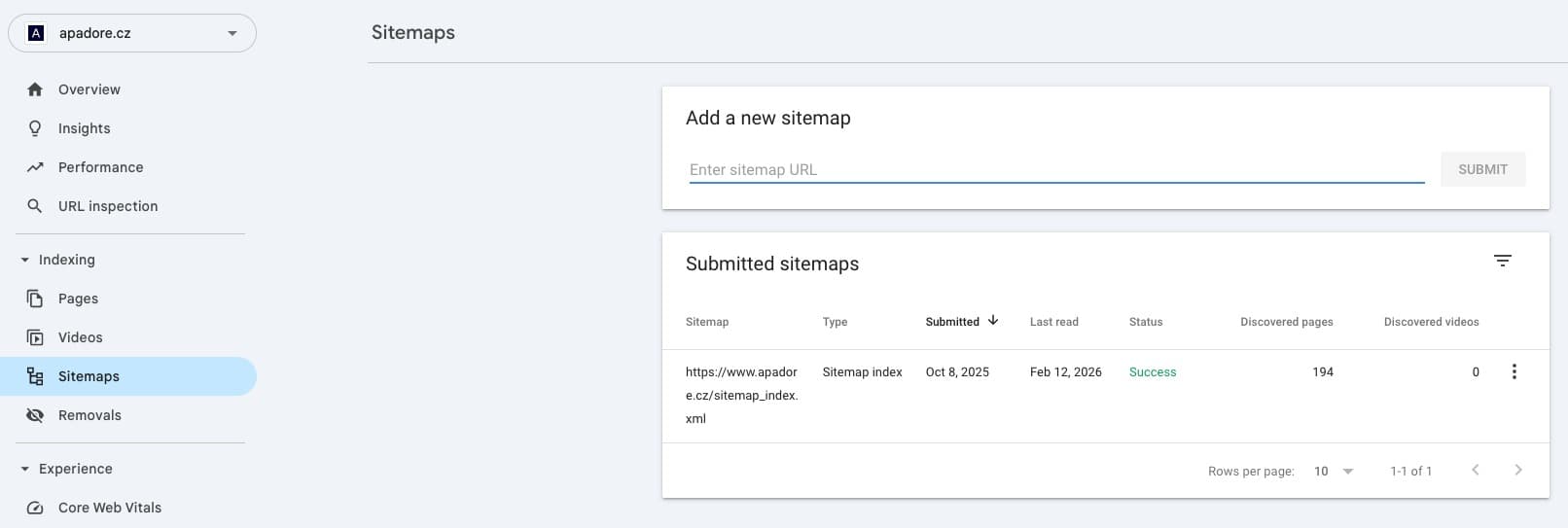
- Uploading the sitemap: In the left menu of GSC, go to the Sitemaps section, enter the URL of your XML file (typically vasedomena.cz/sitemap.xml) and click „Submit“ or „Submit“. Google will load the map and start periodically crawling all of the links listed.
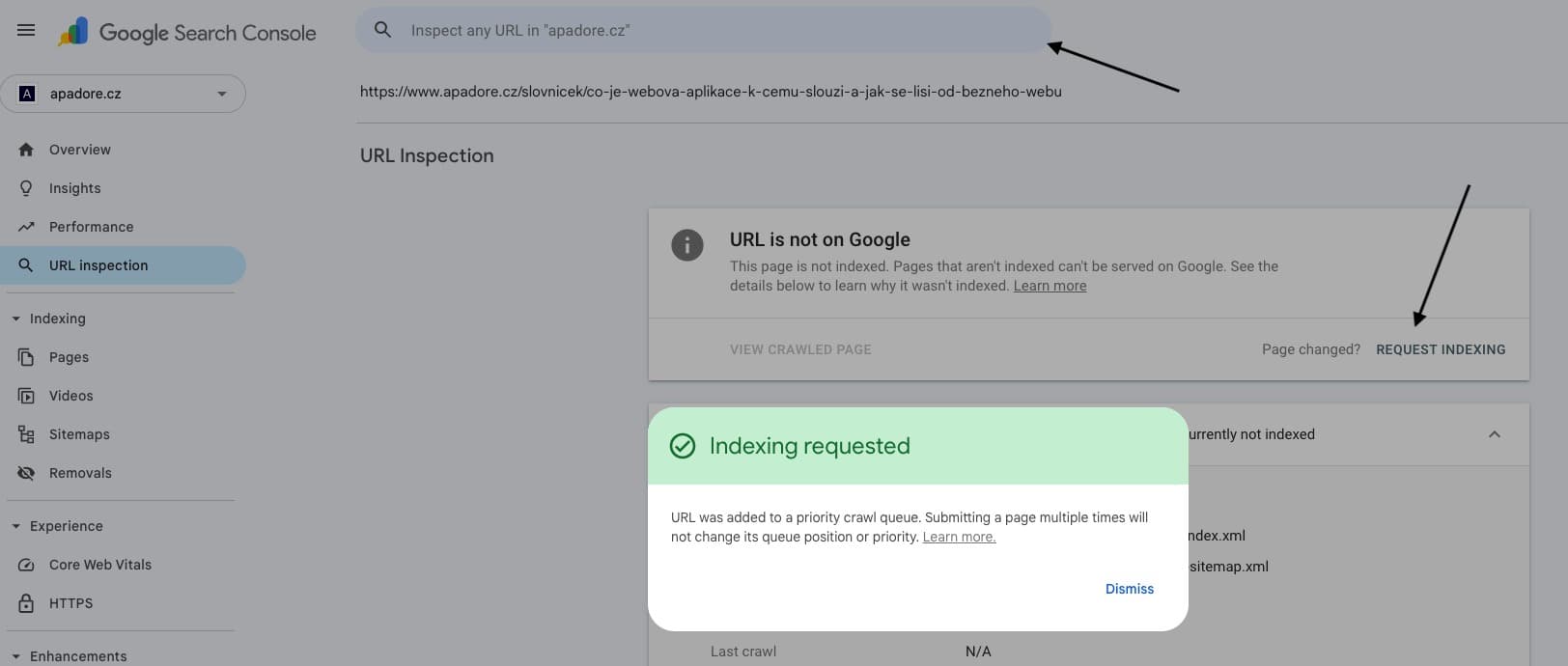
- Manual indexing request: If you are publishing an important news item, enter its exact address in the top search box in GSC and click on Request indexing. This step places your URL in the priority queue for processing.
2. Bing and Bing Webmaster Tools
Although Bing has a smaller market share, it is a significant source of traffic for many segments. In addition, some ChatGPT models also use it for search, so if you want to optimize your site not only for search engines, but also language models, be sure not to forget it. It is also very easy to manage thanks to its close connection to Google.
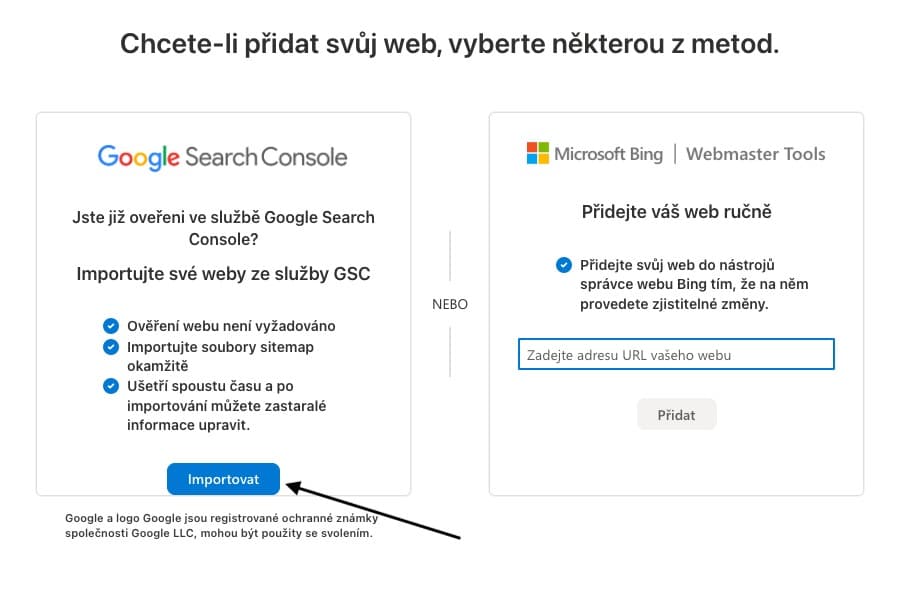
- Quick import of data from GSC: Bing offers a huge advantage - you don't have to verify the site in a complicated way. When you create an account in Bing Webmaster Tools, select the option Import data from Google Search Console. The system will automatically download the verification and the uploaded sitemap, saving you a lot of time.
- Uploading the sitemap: If you don't use the import for any reason, you can simply insert the sitemap manually in the Sitemaps section, using the exact same principle as Google.
New: Bing webmaster tools now shows which pages of your site are cited in AI models and what queries are displayed.
3. Seznam.cz and the IndexNow protocol
Seznam is still very relevant for the Czech market. However, its search robot is often slower than Googlebot, so it is necessary to go a little bit faster.
- IndexNow Protocol: This is currently the most modern and efficient way of indexing. IndexNow is an automated protocol (fully supported by both Seznam and Bing). When deployed, it acts as an instant „ping“. As soon as you publish a new article on the site or edit an existing one, the system automatically sends a message to search engines, to come and download the new version. With websites built by us, you already have this protocol in place and you don't have to worry about anything.
- Manual addition: The list also offers an older, simpler form called „Add page„, where you just need to copy the URL of the new site and confirm its submission to the database. However, this only works with one site at a time, so adding in bulk is tedious.
Why entrust the search engine display of your website to professionals?
Web visibility is a thing, but building strong positions and ranking on the first page that generates over 95 % clicks takes time, regular data analytics, structure adjustments and backlink acquisition. For many companies, it is inefficient to handle these steps internally.
As part of our approach At DFY (Done For You) we take care of the complete process. The client spends minimal time on technical and content operations, while a dedicated team delivers measurable results, monitors current algorithm trends and moves the site safely and systematically towards the first page.
Do you feel that your current website is not reaching its potential in search engines? We are happy to perform a technical and content audit of your site. We will identify the weak points that are hindering your growth and propose a clear strategy for eliminating them. Alternatively, we will design a brand new website that will deliver the results you want. We can discuss all the options at unpaid consultation.
Frequently Asked Questions (FAQ) about indexing and positions
How long does it take for a search engine to index a website?
It depends on the overall authority of the domain and the procedure chosen. If you just start the site and wait, the process may take several days to weeks. However, if you upload a sitemap to GSC, send a manual request or use the IndexNow protocol, the time is usually reduced to a few hours to a few days at most.
Can I force the indexing of pages?
Technically, you can't force a search engine to index a page 100%, but you can maximise the probability by sending a manual request (called Request Indexing). However, if the algorithm evaluates the content of the page as low quality, duplicate or with zero added value, it may refuse indexing despite your explicit request.
How to fix crawling issues?
If Google Search Console reports errors such as „Blocked by robots.txt“, „Redirect page“ or various 404 and 500 errors, it means that the robot has hit a technical snag. In this case, it is necessary to check the server settings, check the validity of the redirection (301 codes) and remove the incorrect directives. Identifying and correcting these errors is typically a task for an experienced developers or SEO specialist.
How can I find out if my page is already ranked in search?
Traditional browser querying is biased by your history, cookies and geographic location. You can find accurate and objective data on what positions your website actually appears in for free in Google Search Console in the Performance tab. Here you can see the exact keywords, average positions and click-through rates (CTR). From the paid tools we recommend Ahrefs, Semrush or Czech Marketing Miner. However, unless you plan to do your own SEO, a paid tool is not a must.