Crawl budget: why does it matter and how do you find out how big it is?
Crawl budget is the number of pages on a website that a search engine (such as Googlebot) can crawl and index within a given period of time. Simply put, it’s how many pages of your website Google manages to fetch and index before it moves on. For smaller websites this is usually not a big issue, but for larger projects the crawl budget can have a major impact on visibility in search results.
How crawl budget works
Crawl budget is affected by two main factors:
- Crawl rate limit – the technical limit, i.e. how many requests Googlebot can send without slowing down the server. If the server is slow or returns errors, Google crawls less intensively.
- Crawl demand – the demand for indexing specific pages. Google focuses mainly on pages it considers important and likely to be valuable to users (e.g. frequently updated pages, popular content, key product pages).
Why crawl budget matters
1. Faster indexing of new content – if a website uses its crawl budget efficiently, new articles and products get into the index faster.
2. Better visibility in Google and other search engines – if part of the crawl budget is wasted on duplicates or technical errors, important content may never get crawled.
3. More efficient management of large websites – for e-shops, magazines and portals with thousands or even millions of pages, crawl budget optimization is essential.
How to find out how big your crawl budget is
Crawl budget is not a number that Google or any other search engine shows directly, but you can estimate it from the available data:
- Google Search Console → In the left menu, go to “Settings”. The “Crawl stats” report shows how many pages Googlebot crawls per day.
- Server logs → the logs show how often search engines visit and which URLs.
- Indirect signals → how quickly new content gets indexed, or whether some important pages stay out of the index.
How to make the most of your crawl budget
- Remove duplicates (e.g. parameterized URLs, duplicate versions of pages).
- Use robots.txt correctly to block unnecessary pages.
- Optimize internal linking so that Google finds important content more easily.
- Speed up your website – Googlebot can crawl a faster website more intensively.
- Keep your sitemap up to date so that Google knows which pages to index.
Summary
Crawl budget is a key factor for websites that want to be sure their important content makes it into search engines. If a website is technically sound and has no unnecessary duplicates, its crawl budget is used efficiently. Poor management, on the other hand, can mean Google wastes time on unimportant content while your key pages stay out of the index.
Redirect chains eat into your crawl budget too. If address A leads to B, B to C, and only C to the destination, the bot has to make four requests instead of one. So always redirect straight to the final address.
Crawl budget isn’t just about traditional search engines. Like Googlebot, AI crawlers such as GPTBot and ClaudeBot also need capacity on your website, and more and more website owners are deciding which of them to let in and which to block. We explain how to find your way around this in our article on AI bots on your website.
 Daniel FišerSEO and Analytics Specialist
Dan has been helping companies grow through SEO, analytics and UX for over 7 years. He believes a successful website has to work for both algorithms and real people. At Apadore he is in charge of the overall visibility strategy: from traditional Google search to optimisation for AI assistants, which is key to a company's success today. He studied marketing management at the Prague University of Economics and Business and previously honed his know-how for brands such as Alza.cz and the family business Klenotnictví Dušák. When he isn't analysing data, he lifts weights, plays badminton or travels.
We write about it
 AI bots on your website: when to let them in, and when to block them?In mid-September 2026, the owner of an e-shop selling sportswear notices that traffic from Google has dropped by a quarter in a week. Yet nobody changed…
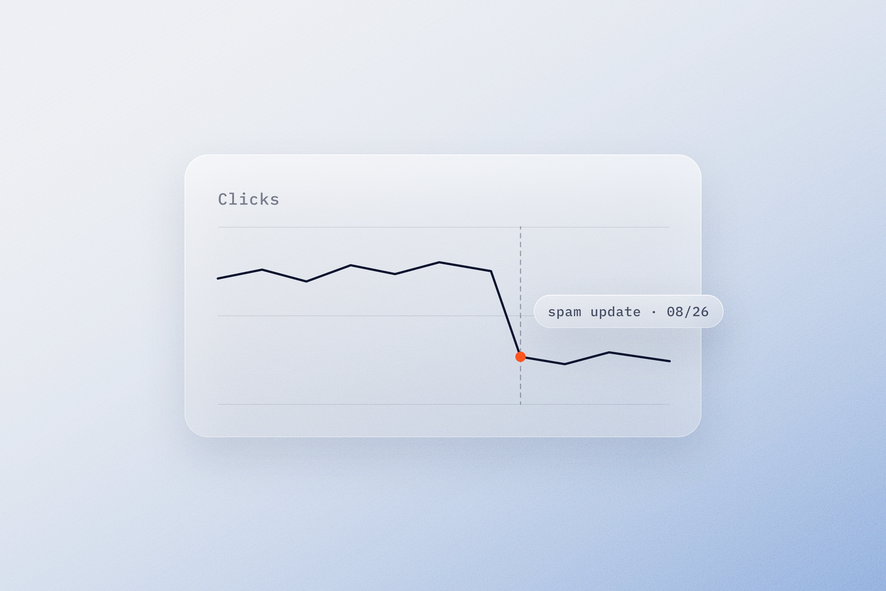 Google spam update, August 2026: did it hit your website? How to tell and what to doOn Monday morning, a business owner opens Search Console and can’t believe their eyes. Traffic from Google dropped by a quarter over the weekend. Yet nobody…
 Website indexability: check whether Google even knows you existBefore customers flock to your website, robots (search engines) first have to discover it and get to know it.