How do you get a website onto the first page of search engines quickly?
The question of how to get onto the first page of Google or Seznam as quickly as possible comes up at the start of almost every digital project. From a business point of view, it’s a perfectly logical goal: visibility brings traffic, and traffic generates conversions. Still, it’s essential to separate marketing myths from the technical and strategic reality of how search engines work.
This article explains how search engines work, why there is no magic button for instant success and which concrete steps lead to the fastest possible growth in organic traffic.
Why there is no such thing as instant SEO
The basic principle of search engine optimization (SEO) is building trust. Search engine algorithms need time to index a website, understand its content and assess the domain’s authority. A new website ends up in the so-called sandbox, where Google tests it before trusting it with top positions for important keywords.
If an agency or consultant promises you “first place within a week”, they are most likely using forbidden (black-hat) SEO techniques. These manipulative methods may bring a short-term spike in traffic, but they inevitably lead to a swift and lasting penalty for the entire website, and recovering from it takes an enormous amount of time and money.
Quick results vs. long-term stability (PPC vs. SEO)
If your business needs traffic right now (for example, to launch a time-limited campaign), organic search is not the right tool.
- PPC (pay-per-click) advertising: This is the only way to get instant visibility. Once you pay for credit, your website immediately appears in the sponsored positions above the organic results. But as soon as the budget runs out, your visibility drops straight to zero.
- SEO (organic search): It builds a long-term digital asset. While with PPC you pay for every click, organic search brings in users steadily, and in the long run the return on investment (ROI) is incomparably higher.
Three pillars: how to grow as fast as possible
Although you can’t skip the process, the right strategy and technical execution can make it significantly more efficient and faster. Success rests on three basic pillars that must all work at the same time.
1. A flawless technical foundation
Search engines prefer websites that are fast, secure and easy to crawl. This is where it becomes clear that good SEO is inseparable from professional web design.
- Loading speed: If a page takes longer than 3 seconds to load, most users leave. Search engines automatically push slow websites further down.
- Mobile responsiveness: Most searches today happen on mobile devices (mobile-first indexing).
- Clean architecture: A logical URL structure and proper internal linking help bots find and index new content faster.
2. Focus on long-tail keywords
The biggest mistake that holds websites back is targeting highly competitive one-word terms (e.g. “furniture”). The fastest way onto the first page is to use long-tail phrases. These are more specific, multi-word queries (e.g. “custom solid oak dining table”). They have lower overall search volume, but they come with minimal competition and huge conversion potential, because the user knows exactly what they want to buy.
3. Content that solves a real problem
Website copy must not be written for search bots but for people. The key is genuine interest in, and a deep understanding of, the problem the user brings to your website. If visitors find a meaningful solution, they spend time on the website and take action (e.g. fill in a form). The search engine reads this behavior as an excellent user experience (UX) and moves the website up in the results.
General principles: how to prepare a website for lightning-fast indexing
Before you start actively submitting your website to search engines, it has to be technically flawless. Even the fastest request will fail if the bot runs into obstacles. Here are the basic steps you always need to take care of, whatever the search engine:
- Generate an XML sitemap: A sitemap works as a digital map of your website that clearly shows bots all existing and important subpages. Our websites give you flexibility and freedom by generating the sitemap fully automatically in the background whenever new content is added.
- Smart internal linking: Isolated pages with no links pointing to them get indexed very slowly. The best strategy is to link to new content from an existing, strong page (for example, linking a new article from a high-traffic home page or from a main service category such as SEO or web design). The bot follows the link and discovers the new page straight away.
- Remove technical blocks (noindex): During development, a website is often hidden from the public with a noindex tag. An extremely common mistake after launch is that the tag stays in the code. Always check the settings, or search engines will ignore the page completely.
- Publish regularly, with added value: Bots come back more often to websites that regularly come alive with new content. But the goal isn’t to churn out empty copy for algorithms. What matters is genuine interest and strategy: only publish content that actually answers the questions and solves the problems of your target audience.
How to get your website into specific search engines
Each search engine has its own quirks and its own tools. Setting up these platforms is a standard part of our approach: our expert team hands the website over to the client already fully connected to the analytics they need, so they don’t have to spend time on technical chores. Still, let’s go through the individual steps that will help make your website visible.
1. Google and Google Search Console (GSC)
Google is the global search leader, and you can’t manage a website without its free Search Console. It is the main communication channel between you and the search engine.
- Submit your sitemap: In the left menu of GSC, go to the Sitemaps section, enter the URL of your XML file (typically yourdomain.com/sitemap.xml) and click “Submit”. Google loads the map and starts regularly crawling all the links in it.
- Request indexing manually: If you publish something important, paste its exact address into the search field at the top of GSC and click Request indexing. This puts your URL in the priority queue for processing.
2. Bing and Bing Webmaster Tools
Bing has a smaller market share, but for many segments it is a significant source of traffic. Some ChatGPT models also use it for search, so if you want to optimize your website not just for search engines but also for language models, don’t leave it out. Thanks to its close integration with Google, it is also very easy to manage.
- Quick import from GSC: Bing offers a big advantage: you don’t have to go through a complicated website verification. When you create your Bing Webmaster Tools account, choose Import from Google Search Console. The system automatically pulls in both the verification and the submitted sitemap, saving you a lot of time.
- Submit your sitemap: If for any reason you don’t use the import, simply add the sitemap manually in the Sitemaps section, exactly as in Google.
- New: Bing Webmaster Tools now shows which pages of your website are cited in AI answers and for which queries.
3. Seznam.cz and the IndexNow protocol
For the Czech market, Seznam is still very relevant. Its crawler, however, is often slower than Googlebot, so it pays to meet it halfway.
- The IndexNow protocol: This is currently the most modern and efficient way to get indexed. IndexNow is an automated protocol (fully supported by both Seznam and Bing). Once it is set up, it works like an instant “ping”. As soon as you publish a new article or update an existing one, the system automatically notifies the search engines to come and fetch the new version. Websites we build have this protocol set up already, so you don’t have to worry about a thing.
- Adding pages manually: Seznam also offers an older, simpler form called “Přidej stránku” (Add a page), where you just paste the URL of the new website and confirm its submission to the database. It only works for one page at a time, though, so adding pages in bulk is tedious.
Why leave your search visibility to professionals?
Getting your website to show up is one thing, but building strong positions and a place on the first page, which gets over 95% of all clicks, takes time, regular data analysis, structural adjustments and link building. For many companies, handling these steps in-house is inefficient.
With our DFY (Done For You) approach, we take care of the whole process. The client spends minimal time on technical and content chores, while a specialized team delivers measurable results, keeps an eye on the latest algorithm trends and moves the website safely and systematically toward the first page.
Do you feel your current website isn’t reaching its potential in search? We’ll be happy to run a technical and content audit of your website. We’ll identify the weak spots holding back your growth and propose a clear strategy for fixing them. Or we can design a brand-new website that delivers the results you want. We can talk through all the options in a free consultation.
Frequently asked questions about indexing and rankings
How long does it take for a search engine to index a website?
It depends on the overall authority of the domain and the approach you choose. If you simply launch the website and wait, the process can take several days to weeks. But if you submit a sitemap in GSC, send a manual request or use the IndexNow protocol, it usually shrinks to a few hours or, at most, a few days.
Can I force a page to be indexed?
Technically, you can’t force a search engine to index a page with 100% certainty, but you can maximize the chances by sending a manual request (Request indexing). However, if the algorithm judges the page’s content to be low quality, duplicate or of zero added value, it may refuse to index it despite your explicit request.
How do I fix crawling issues?
If Google Search Console reports errors such as “Blocked by robots.txt”, “Page with redirect” or various 404 and 500 errors, the bot has hit a technical obstacle. In that case, you need to check the server settings, verify that your redirects (301 codes) are valid and remove any incorrect directives. Finding and fixing these errors is typically a job for an experienced developer or SEO specialist.
How do I find out whether my page already ranks in search?
Typing queries into your browser gives skewed results because of your history, cookies and location. You can find accurate, objective data on where your website really ranks for free in Google Search Console, under the Performance tab. There you’ll see the exact keywords, average positions and click-through rate (CTR). Of the paid tools, we recommend Ahrefs, Semrush or the Czech Marketing Miner. But if you don’t plan to do SEO yourself, you don’t need a paid tool.
 Daniel FišerSEO and Analytics Specialist
Dan has been helping companies grow through SEO, analytics and UX for over 7 years. He believes a successful website has to work for both algorithms and real people. At Apadore he is in charge of the overall visibility strategy: from traditional Google search to optimisation for AI assistants, which is key to a company's success today. He studied marketing management at the Prague University of Economics and Business and previously honed his know-how for brands such as Alza.cz and the family business Klenotnictví Dušák. When he isn't analysing data, he lifts weights, plays badminton or travels.
We write about it
 Website indexability: check whether Google even knows you existBefore customers flock to your website, robots (search engines) first have to discover it and get to know it.
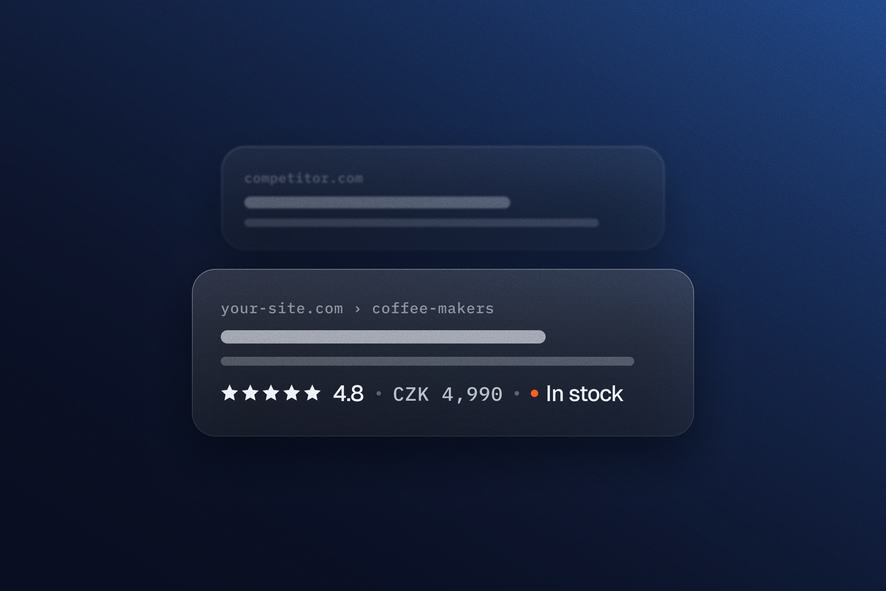 Structured Data: What It Really Brings to a Company's Website and Online Store TodayA customer searches Google for a specific coffee maker. Below the search results, they see two online stores. The first one shows only a title and a…
 Does the internet know about your company? This 2-minute test will tell youIt takes two minutes, and it’s the fastest way to find out if the internet even knows you exist. Most companies haven’t tried it yet, even though this is…